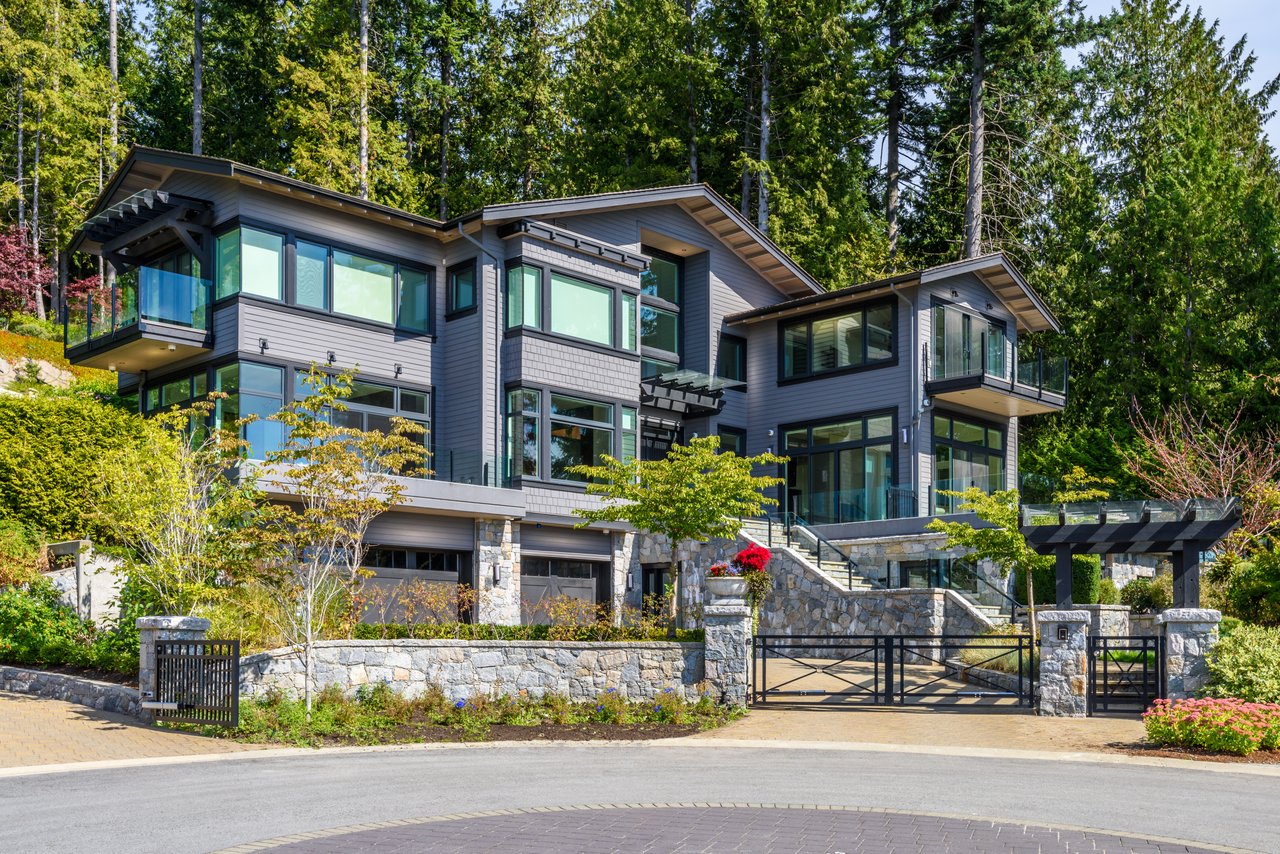
Two homes go on the market a few doors apart on the Point Holmes side of the Comox Peninsula. One sits closer to the water with a dock in the listing photos and asks something north of $2 million. The other sits back from the shoreline, has no marine access at all, and asks somewhere in the low $1 million range. A buyer scrolling both listings back to back reaches an obvious conclusion: the extra $900,000 or so buys the water.
It doesn't, not entirely. What that premium actually secures is scarcer than most buyers assume, and what it doesn't secure is the exact thing the photo is selling.
What "Waterfront" Actually Buys You Under BC Law
In British Columbia, a residential title generally runs to the surveyed property line, and that line stops at the natural boundary, the point marked by the ordinary high-water mark. Everything below that line, the beach itself and the tidal foreshore, is Crown land. You can own a home with your feet on the sand at low tide and still not own the sand.
That distinction matters more on the Comox Peninsula than almost anywhere else in the Comox Valley, because the Peninsula is where the water-adjacent inventory concentrates: Goose Spit, Croteau Beach, Point Holmes, Astra Bay and Kin Beach, Bates Beach, Balmoral Beach, Little River, and Cape Lazo. These are the addresses that carry the waterfront premium. They're also the addresses where the dock, the ramp, or the buoy in the listing photo sits on land the seller never actually owned.
The Permission Layer Nobody Puts In The MLS Description
A dock on Crown foreshore exists because someone was granted permission to put it there, not because it came bundled with the upland lot. The province authorizes private moorage three different ways, and which one applies to a given dock changes what a buyer is actually inheriting.
| Authorization type | When it applies | Cost | Term |
|---|---|---|---|
| General Permission | Dock meets standard requirements, no application filed | No fee | Runs as long as the dock owner needs it, revocable |
| Specific Permission | Dock doesn't meet standard requirements, or sits in an application-only area | One-time $250 application fee | Case by case |
| Lease | Substantial investment, or precise boundaries needed to avoid conflict with neighbors | $200 minimum annual fee | Up to 20 years |
Vancouver Island and the Gulf Islands fall under a partial application-only designation for new docks. That means anyone proposing a dock that doesn't already exist has to file an application before it can be authorized at all. There's no shortcut version for a brand-new structure just because the upland lot changed hands.
Existing Docks Get An Easier Path. New Ones Don't.
Here's the part that actually changes how a buyer should read two competing listings. If a dock already exists and already has an authorization in place, when that authorization comes up for renewal it typically gets granted as a General Permission, provided it still meets the requirements. The system is built to keep grandfathered docks in place with minimal friction.
A promise to build a dock is a different transaction entirely. That's a new structure in an application-only region, which means paperwork, a review, and no guarantee of the outcome before you own the property.
So a listing with a decades-old dock and a clean authorization history is not equivalent to a listing with a buildable waterfront lot and a verbal assurance that "you could put a dock in." One of those is close to a sure thing. The other is a bet on a provincial application you haven't filed yet.
The Buoys Are Even Softer Ground
If the marine access in question is a mooring buoy rather than a dock, the ground gets softer still. The province generally does not issue leases or licences to occupy for private mooring buoys, reserving that option for cases involving substantial investment. Bays like Comox already carry so many private buoys that transient boaters have a hard time finding room to anchor safely.
That density doesn't mean the buoys are authorized. Long-term or permanent mooring, particularly when the owner isn't aboard, falls outside the public right of navigation according to a 2013 BC Supreme Court ruling, and a buoy placed without provincial permission is technically in trespass. In practice the province rarely enforces against individual buoys. In principle, a buyer who assumes a photographed buoy conveys the same certainty as a titled parking spot is assuming something the law doesn't back up.
Town Limits Stop Being The Relevant Map
One more wrinkle that trips people up: the Town of Comox runs its own municipal marina, its own zoning bylaw, and its own fee schedule for moorage and boat launches within town boundaries. That's a real, functioning system with published rates and a Town Hall counter to pay them at.
But most of the premium waterfront addresses on the Peninsula, the ones named above, sit outside those town boundaries entirely. Out there, it's the Comox Valley Regional District's zoning and the provincial Crown land process that govern what you can build and where, not a municipal marina office. A buyer comparing a townhome near the Comox Municipal Marina to an acreage on Balmoral Beach is comparing two different regulatory environments, not two flavors of the same rulebook.
What The Premium Actually Reflects
None of this means waterfront isn't worth the money. It means the money is buying something narrower and scarcer than "guaranteed private marine access forever."
Median sale prices across the Peninsula's broader single-family market moved from roughly $1.09 million in 2022 down to just under $1.0 million in 2023, then recovered to about $1.16 million in 2025 and roughly $1.19 million year to date in 2026, a band a local appraisal firm's analysis found the broader market has generally held between $1.0 million and $1.2 million throughout. Waterfront sales ran in a different bracket the entire time, holding between roughly $1.5 million and nearly $2.5 million since 2022 and commanding a significant premium over non-waterfront homes, with the 2026 year-to-date median sitting just above $2.0 million. Active inventory in mid-June 2026 told the same story from the supply side: twenty single-family listings on the Peninsula, only six of them waterfront.
That gap is a scarcity premium for frontage, view, and privacy on a stretch of coastline with almost no undeveloped lots left. It is not a line-item payment for a dock authorization, a buoy, or a lease that automatically follows the deed. Those are separate instruments, held by the province, and a change of ownership doesn't rewrite them on its own.
Questions Worth Asking Before You Waive Subjects
A buyer working through a waterfront offer on the Peninsula gains more from four specific questions than from any general enthusiasm about the view:
Ask for the actual tenure document, not a verbal description of "the dock rights." A General Permission, a Specific Permission, and a lease are not interchangeable, and only one of them comes with a fixed multi-year term.
Ask whether that tenure has ever required upland-owner consent from a neighboring property, since access to deep water sometimes crosses adjacent Crown frontage.
Ask directly whether a mooring buoy has any provincial paperwork behind it or whether it's simply been there long enough that nobody's questioned it.
Ask what happens if the current authorization is up for renewal during your subject period, since an existing dock renewing under General Permission is a very different risk than a first-time application.
FAQ
Does a foreshore lease or dock permission transfer automatically when I buy a waterfront home? No. These are provincial authorizations tied to an application and a holder, not automatic riders on a land title. A buyer typically needs to confirm assignment or reapply, and the province can require consent and a rent review as part of that process.
Why does it matter whether a property is inside Town of Comox limits or out on the Comox Peninsula? Because the rulebook changes. Inside town limits, the Town's own zoning bylaw and municipal marina system apply. Out on the unincorporated Peninsula, it's Comox Valley Regional District zoning plus direct provincial Crown land process, with no municipal marina office standing between you and FrontCounter BC.
Can I just put in my own mooring buoy if I buy a waterfront lot? Legally, no, not without provincial authorization, and the province is often reluctant to issue new leases for private buoys outside cases of substantial investment. Enforcement against existing buoys in crowded bays tends to be light, but light enforcement isn't the same as a clean legal claim.
Waterfront math on the Comox Peninsula isn't hard once you know which parts of the price tag are guaranteed and which parts are a paperwork trail you inherit. If you're comparing listings on Point Holmes, Croteau Beach, or anywhere else along that shoreline and want someone to pull the actual tenure documents before you write an offer, Stevie Cauvier has been through this exact due diligence with Comox Valley waterfront buyers before. Start your move, book a Home Hunting Trip and get the paperwork checked before the subjects come off.