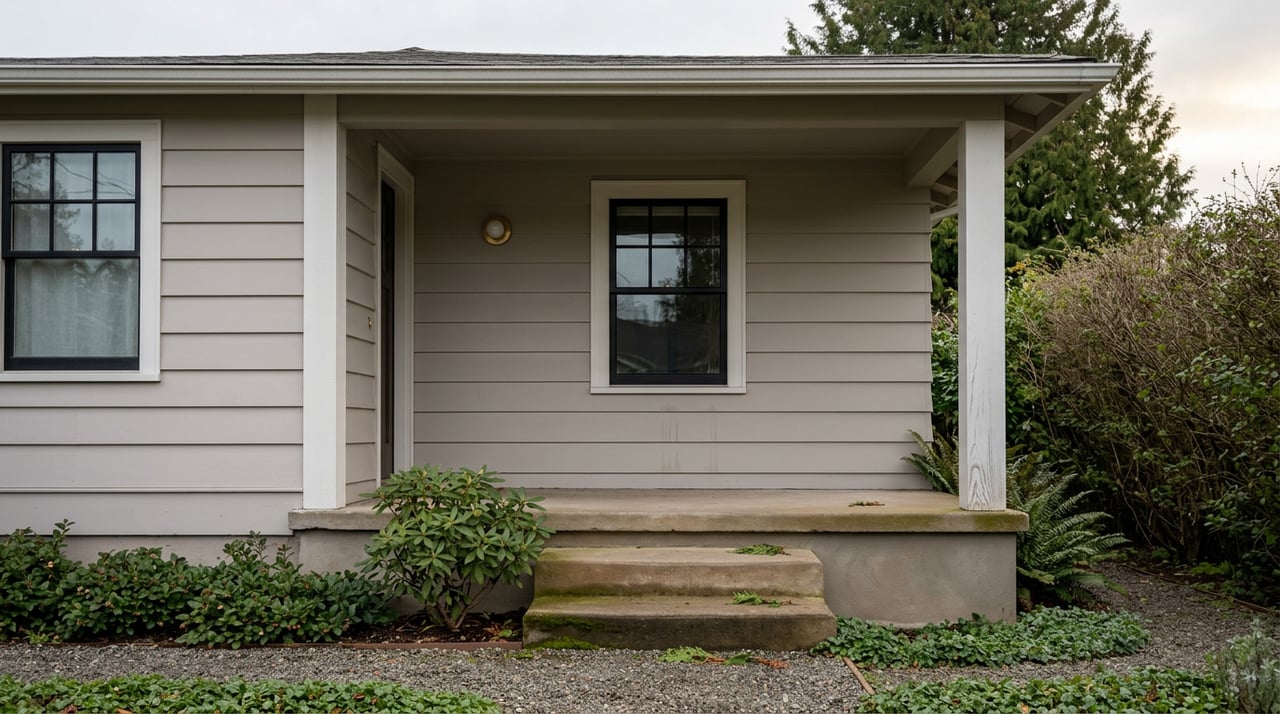
Walk down almost any side street off Dunsmuir Avenue and there is a decent chance you are standing in front of one of the Bevan Houses without knowing it. Thirty-seven of them were built in 1910 and 1912 as company housing for mineworkers' families, then hauled seven kilometres into Cumberland in 1918 when the No. 7 mine seam gave out. The Village recognized them as heritage buildings in 2024. They are not a museum piece set apart from the market. They are woven into the residential grid, sitting on ordinary streets next to homes from every decade since.
That is the condition of buying in Cumberland. The village ran as an eight-mine coal operation from the 1880s until the last mine finally closed in 1966, and the housing that got built to support that economy is still the housing you tour today. A lot of buyers walk into an inspection assuming the scary finding is going to be the wiring itself. It usually is not. The finding that actually stalls a deal is one word an inspector writes down, and most buyers do not know to ask about it until their insurance broker calls with bad news.
Why so much of Cumberland's stock predates modern wiring standards
Two eras dominate what is actually for sale in the village. The oldest layer includes homes like the Bevan Houses and other early 1900s company housing, built when the settlement was still called Union and Robert Dunsmuir was expanding it to feed eight mines. The second, more common layer is the mid-century single-family home built as the village stabilized after mining wound down, the kind of large two-storey house Comox Valley locals often call a Comox Box, built with room to grow and finished basements that later became mortgage-helper suites.
Both eras predate the electrical code most Canadian homes are wired to today. Knob and tube wiring, the ceramic-knob-and-tube system that ran two separate ungrounded wires through house framing, was standard through the 1940s and lingered into some builds after that. If your Cumberland character home was built before roughly 1950 and has never had a documented, permitted full rewire, an inspector is going to assume knob and tube is present somewhere in the structure. That assumption costs the buyer nothing. Assuming it is gone and being wrong is the expensive mistake.
The word that decides more than the wiring itself
Here is the distinction that actually matters at the negotiating table, and it is the one most buyers miss entirely: insurers and lenders do not treat all knob and tube the same way. They treat presence and active status as two different questions.
A home can have knob and tube wiring present in an attic or wall cavity and be perfectly insurable if that wiring has been properly disconnected, isolated, and documented as no longer carrying current. The problem is active knob and tube, meaning wiring still energized and doing electrical work in the house, especially if it has been extended, spliced, or tied into a modern circuit without a permit. That is the scenario where BC insurers have been tightening terms. Some carriers have stopped writing new policies on homes with active knob and tube circuits altogether. Others will still insure them but at a noticeably higher premium, or only after a licensed electrician's inspection report confirms the wiring is no longer in service. A smaller number will insure the home only on the condition that the buyer commits to partial or full replacement within a set window after closing.
That distinction is the whole ballgame. Two houses on the same street can both show up on an inspection report with the phrase "knob and tube wiring present," and one of them closes without a hiccup while the other turns into a financing headache, purely because one seller can produce paperwork showing the old wiring was retired and the other cannot.
Here is roughly how those three scenarios tend to play out once they reach an insurance underwriter:
| What the inspection finds | What it usually means for insurance and financing |
|---|---|
| Knob and tube present but documented as disconnected, with a licensed electrician's report confirming it is not in service | Most insurers will write a standard policy without much friction |
| Knob and tube present, status unclear or undocumented, no electrician's letter on file | Expect the insurer to request an inspection before quoting, which adds time to your subject-removal timeline |
| Knob and tube confirmed active, especially feeding kitchen, bathroom, or laundry circuits | Expect a higher premium, a required replacement timeline, or a straight decline from some carriers, which then puts mortgage approval at risk |
The middle row is where most Cumberland deals actually sit, because most sellers of a 1910s or 1950s home have never had this conversation with an electrician and have no letter to hand over. That is not a red flag on its own. It just means the paperwork has to get created during your subject period instead of before it.
Who actually gets called in to answer the question
Comox Valley buyers touring Cumberland listings tend to hire from a fairly small, known bench of local inspectors. Clarity Home Inspections lists Cumberland among the communities it covers out of Courtenay and has picked up regional readers' choice recognition along the way. Dovedale Home Inspections also names Cumberland directly among the areas it serves and advertises next-business-day reports, which matters when your subject removal clock is running. Mindful Inspections, led by Pam BeynonBrown, covers the same Cumberland-to-Campbell-River stretch and has a track record of helping clients get exactly the documentation an insurance company will ask for. Capri Home Inspections, run by Marc Halliwell, works the broader Comox Valley and is another name worth having on your shortlist.
None of these inspectors can waive a bad electrical finding away. What a good one does is give you language precise enough to hand to an insurance broker the same week, instead of a vague note that sends everyone back to square one.
The conversation worth having before you remove subjects
If your Cumberland offer includes a home inspection subject and the report comes back flagging knob and tube, do not treat it as an automatic walk-away and do not treat it as a non-issue either. A few moves tend to save the deal:
- Ask the inspector directly whether the wiring reads as active or disconnected, not just present. That single word changes your next step.
- If it reads as active, request that the seller produce or pay for a licensed electrician's assessment before you remove subjects, rather than discovering the insurance snag after you have already waived conditions.
- Call your insurance broker during your subject period, not after. Getting a quote in hand while you still have an out is worth more than getting one after removal.
- If replacement turns out to be necessary, get a written estimate from a licensed electrician so you know whether you are negotiating price, negotiating a seller credit, or negotiating a longer close to allow work before possession.
This is the kind of detail that turns a scary-sounding inspection line item into a manageable checklist, and it is exactly the kind of paperwork chase a detail-oriented buyer's agent should be running down on your behalf rather than leaving you to sort out with an insurance call center.
FAQ
Does every home built before 1950 in Cumberland have knob and tube wiring? Not every one, since some have had full rewires over the decades, but the safe assumption on any character home in the village is that it is present until an inspection proves otherwise.
Is knob and tube wiring against BC building code? Dan Wilcox Electric says existing knob and tube is allowed to remain if it is undisturbed and unmodified, but any new electrical work or renovation touching those circuits has to meet current code, and active knob and tube cannot legally be extended.
Can I get a mortgage on a Cumberland home with active knob and tube wiring? Often yes, but your lender is watching your insurance approval closely, since most lenders require proof the property can be insured, and an insurer that declines or heavily conditions coverage can stall financing even when your own credit and down payment are solid.
Cumberland's character homes are part of what makes the village worth choosing over a newer build elsewhere in the Comox Valley, and a knob and tube finding on an inspection report is a negotiation point, not a verdict. If you are weighing one of these listings and want someone who will run the insurance and electrician conversation down before you are locked into removing subjects, Stevie Cauvier has been through this exact sequence with Cumberland buyers before. Start your move and book a Home Hunting Trip with Stevie today.
This article is general information, not legal, tax or financial advice. Consult a qualified professional about your situation.